Dry Erase Wall Calendar: The Month Glance Your Screen Cannot Give You
A dry erase wall calendar turns an empty wall into a month you can see from across the room. What the magnetic whiteboard version gets right, and the care it demands.
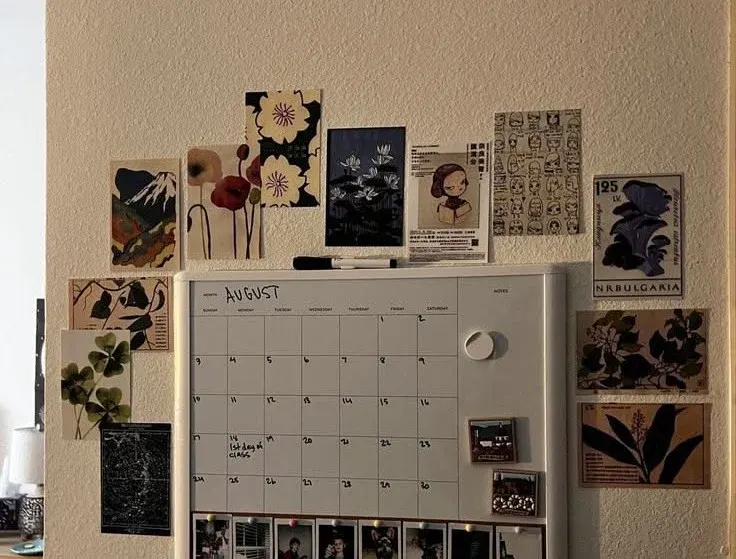
A calendar app has every feature except the one that matters in a shared room: nobody walks past your phone and absorbs the week. The board in the photo solves that with a white wall calendar hanging where the walls already have prints and polaroids, a month grid you can read from across the room, and magnets holding photos on the cells that have no plans. The marker sits on the tray at the top, the month is written by hand, and the notes column on the right takes the overflow that does not fit any single day.
What Exactly Is a Dry Erase Wall Calendar?
It is a printed whiteboard, and the printing is what separates it from drawing your own grid with a ruler. The WALGLASS board ships with the month skeleton already on the surface: seven day-labeled columns, six week rows, a notes strip, and a marker tray mounted under the writing edge. You write the month name, fill the cells, and at month end you wipe the whole thing with any dry erase eraser. Nothing is torn off, nothing runs out, and the board holds the same surface for years.
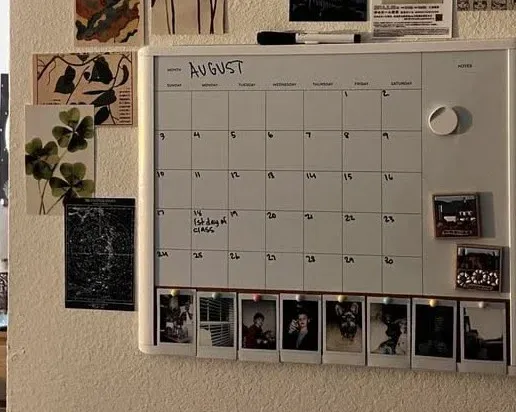
The second part is the magnetic coating. The printed surface is a ferrous layer under the dry erase film, so magnets stick anywhere on the grid. That is how the board in the photo carries polaroids in a row along the bottom edge and photo squares in the notes column: plans on the cells, pictures on the magnets, and the wall around the calendar stays free for prints. One surface holding both ink and magnets is why the category beats both pinned paper calendars, which hold neither well, and phone calendars, which hold nothing anyone sees unless they unlock a screen.
Fitting a Two Meter Planning Habit Into One Wall
The promise of a month board is that one glance replaces opening an app. It works when the board sits on a wall you cross daily, in a hallway, above a desk, next to the kitchen door. At 91.4 cm wide, the WALGLASS board reads like a real calendar from three meters away, and the individual cells are large enough for two or three words in ordinary marker handwriting plus a small magnet. Fitting it on the wall takes two compatible hooks and ten minutes: the board hangs on brackets at the top, the tray rides below, and no screws touch the writing surface.
The honest failure mode is visual clutter. A month grid lives among the rest of the wall, and if the wall already carries a gallery of prints, the board competes with the decor rather than disappearing into it. The owner of the wall in the photo leaned into that: white frame, matching white marker tray, and the calendar reads as one more piece in a wall of paper art. On a bare wall it is invisible; on a busy wall it needs a frame color that belongs.
The Wipe Habit: Where These Boards Go Wrong
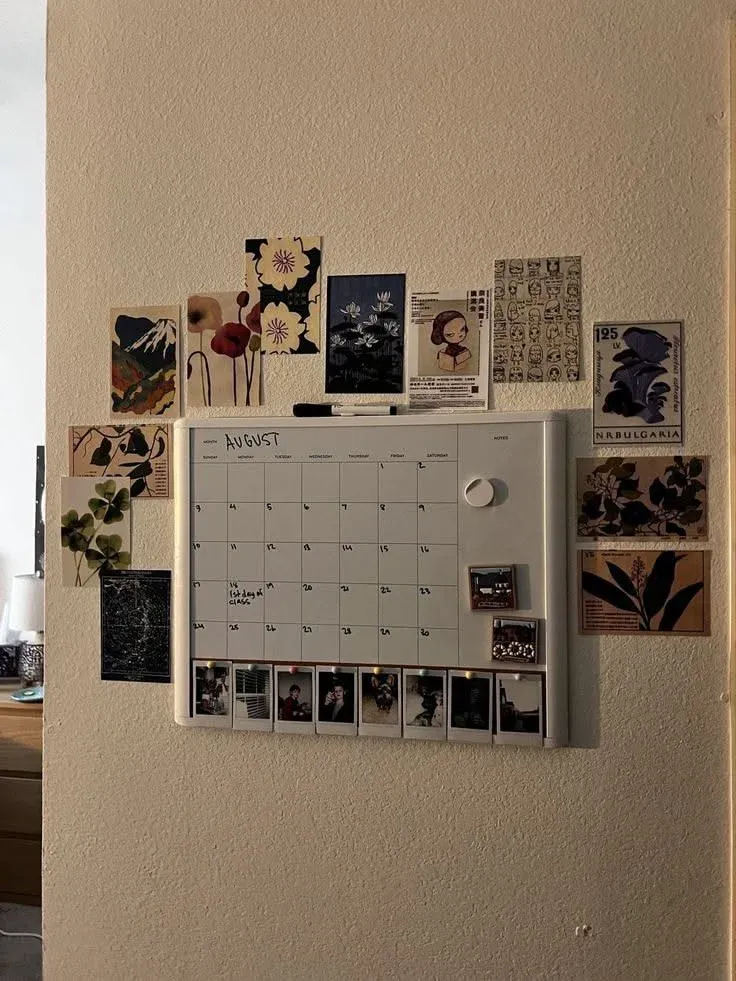
Dry erase ink is not permanent, but it ages. A cell written on Monday and ignored until month end wipes clean. A cell written in week one and left through two months of cycles ghosts, and the only cure is isopropyl alcohol and patience. Cheap markers make this worse: low-pigment ink smears when you erase over neighboring cells, and one dried-out marker scratching on the surface can leave a permanent score line. The marker in the photo lives on the tray, which is the right habit, because capped markers stored on a warm shelf above a radiator dry out in weeks.
Care facts worth knowing before buying: the surface wipes with the eraser that ships in the box or any felt block, permanent damage comes from solvent-based ink left to bake, and ghosting is reversible with alcohol for the first few cycles. The one thing that kills a calendar whiteboard is writing the grid divisions with a Sharpie to customize rows. That ink bonds to the coating within hours, and no cleaner in the box range removes it.
Verdict
Two kinds of buyers get their money’s worth from a wall calendar whiteboard: households where two or more people need the same schedule visible in one shared room, and home office workers who want the month out of a screen and in their face while they work. Around 88 euros for the WALGLASS 91.4 by 61 cm board sits above tape-on planners, and the framing, magnetic surface, and tray justify the gap if the board is going on a wall you look at daily.
✅ Pros
- Printed month grid wipes clean each month, nothing torn or discarded
- Magnetic surface holds photos, magnets, and notes on the same surface cells
- 91.4 x 61 cm is readable from across a standard room
- Aluminum frame with tray and hanging brackets, mounts without hardware in the board
- 4.6 out of 5 on Amazon.de from buyers using it for shared household schedules
❌ Cons
- Around 88 euros is steep next to the 10 to 20 euro tape-on alternatives
- Month cells hold only a few words each; no room for detailed daily tasks
- Ghosting if ink sits in cells for more than a few weeks
- Needs a wall that can take two hooks at 91 cm spacing
🏷 More wall planners Monthly Whiteboard Planners on Amazon → · Family Wall Planners →
FAQ
What is a dry erase wall calendar?
A whiteboard printed with a month grid: seven day columns, five or six week rows, plus a notes strip below. You write the month header with a marker, wipe it clean at the end of the month, and start over. The surface is magnetic, so photos and reminders can hang right on the grid with magnets, which is how the board in the photo holds polaroids in a row along its bottom edge.
How big is the WALGLASS calendar board?
The WALGLASS monthly calendar whiteboard is 91.4 by 61 cm, which is a full month grid you can read from the other side of a room. The aluminum frame has a marker tray along the bottom edge and two hanging brackets, so it mounts on wall hooks without any hardware in the board itself.
Do dry erase markers stain whiteboard calendars?
Ordinary dry erase ink wipes off for months, but any marker left on the grid for weeks bakes in and needs isopropyl alcohol to lift. The trick that keeps a calendar board looking new: erase cells promptly, and never trace your plan with a permanent marker. Ghosting on the old board in the photo came from ink that sat through two month cycles.
Can a wall calendar whiteboard replace a paper planner?
For family logistics and shared schedules, yes: it is visible to everyone in the room and it never runs out of pages. For detailed daily task lists, a paper planner wins, because a wall grid cell holds only a few words. Most people who buy the board use both: the wall calendar for appointments everyone must see, the planner for private task detail.
Is the WALGLASS dry erase calendar worth it?
For around 88 euros as of November 2026 it costs more than the tape-on plastic planners, and the difference shows in the frame, the magnetic surface, and the marker tray. If you want one shared month view that looks decent in a kitchen or home office, it is a reasonable buy. If your wall space is small or you want a five euro solution, start with a smaller board.

Continue reading

Arch Pegboard Gym Storage: The Freestanding Rack That Ends Corner Chaos
A freestanding wooden arch pegboard organizer for yoga mats, dumbbells, kettlebells and bands. What it holds, what it wobbles on and what to buy instead.

Pink Shower Caddy With Shelf: The Pastel Bathroom Organizer That Holds Shampoo, Soap And A Razor
A pink wall mounted shower caddy with two shelves and hooks carries the full bath routine in a marble shower. What the OYRREU no-drill racks actually hold.

Pegboard Home Gym Organizer: The Wall Storage Fix for Small Home Gyms
A pegboard wall turned our heap of gear into one clean display. Here is how a pegboard home gym organizer works, what it holds, and whether it is worth it.