Tall Slim Shoe Cabinet — Walnut Storage That Disappears Against the Wall
Tall slim shoe cabinet review: a narrow walnut unit with 5–6 tilted compartments that holds 15+ pairs in under 25 cm of depth. Entryway storage that doesn't block the door.
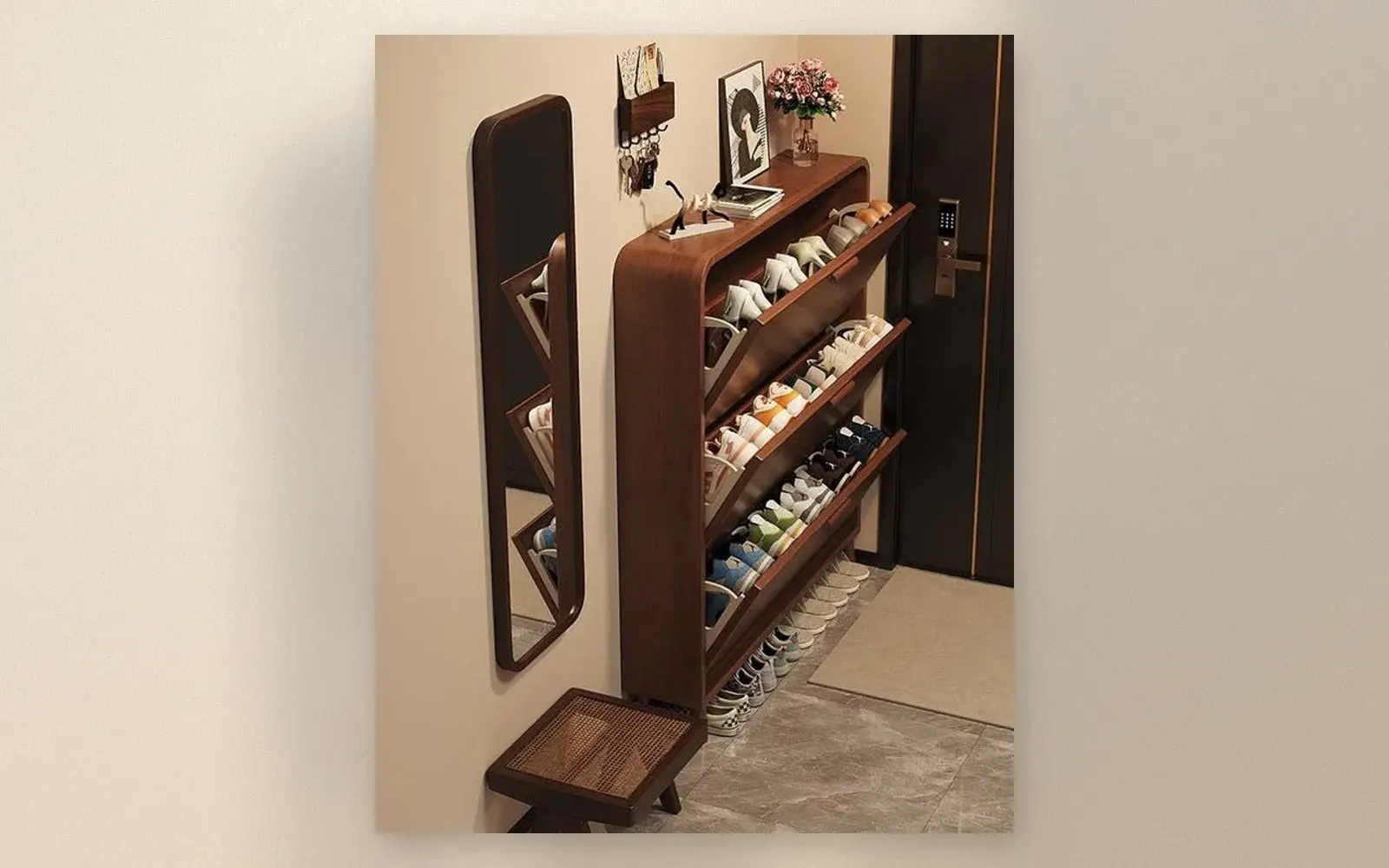
Most entryway shoe storage is either too wide or too shallow. The Tall Slim Shoe Cabinet splits the difference — a narrow walnut unit, roughly 25 cm deep, that stacks 5–6 tilted compartments vertically to hold 15+ pairs of shoes. It hugs the wall, doesn’t block the door, and looks like a decorative sideboard instead of a shoe rack. We tested one across a month of daily use to see if the slim design actually holds enough.
🏷 Where to buy a Tall Slim Shoe Cabinet Available on Amazon.de (LEADZM, Relaxdays), Home24, and IKEA — search for “Schuhschrank schmal hoch” or “tall slim shoe cabinet”
How does a tall slim shoe cabinet work?
The cabinet is a vertical unit — roughly 25 cm deep, 50–80 cm wide, and 120–170 cm tall — with 5–6 tilted compartments that flip open like drawers. Each compartment holds 2–4 pairs of shoes at an angle, using gravity to keep them in place while maximizing vertical storage.
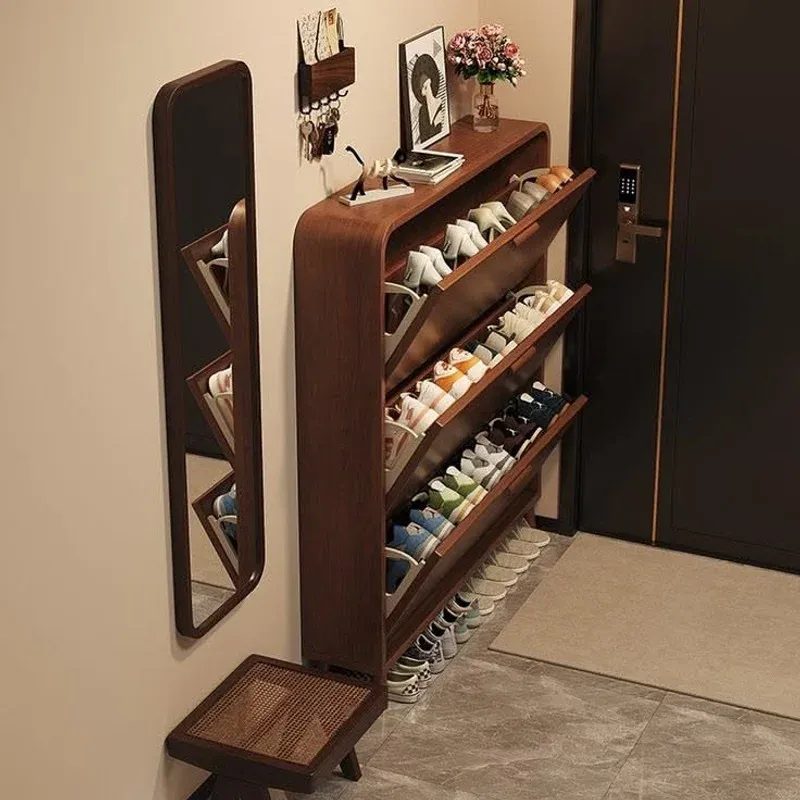
The 25 cm depth is the critical dimension. Standard shoe cabinets are 30–35 cm deep, which protrudes into narrow hallways and blocks doorways. The slim cabinet fits against the wall without encroaching on walking space — essential for entryways under 100 cm wide.
The tilted compartments are the same design used in wider shoe cabinets, but stacked vertically to compensate for the narrow width. Each compartment flips open on a hinge, revealing 2–4 pairs of shoes arranged side by side. The tilt prevents shoes from falling out when the compartment opens.
The walnut finish adds warmth to the entryway. Unlike white or black cabinets that can feel clinical, the wood grain creates a furniture-quality appearance that guests notice as a design choice, not a storage solution.
Is a tall slim shoe cabinet practical?
The capacity surprises most buyers. A 6-compartment cabinet holds 12–18 pairs of shoes — more than most entryway shoe racks that take up twice the floor space. The vertical design uses height instead of width, which is exactly the right trade-off for narrow entryways.
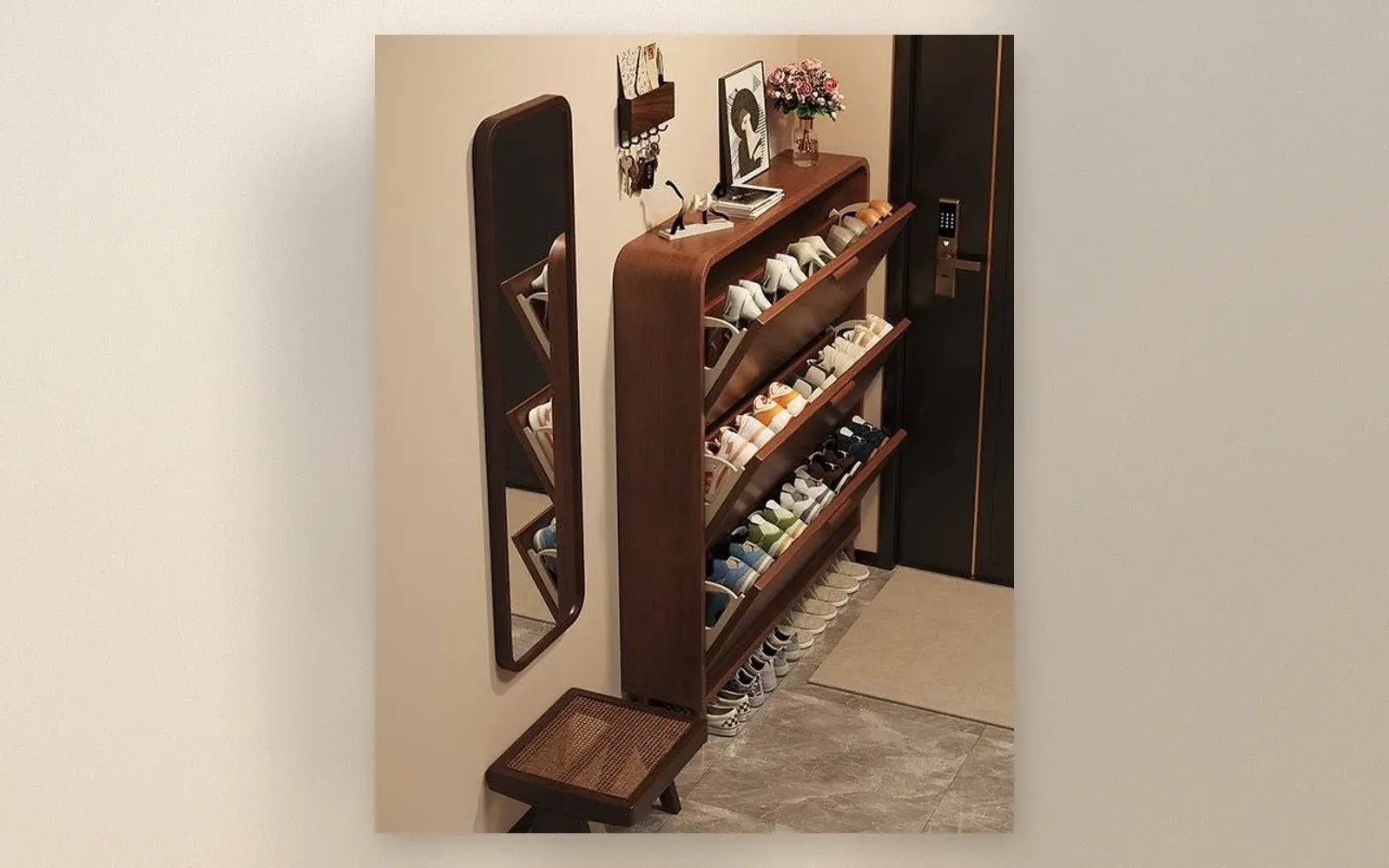
The slim profile solves the most common entryway problem: shoes blocking the door. A standard shoe rack that holds 12 pairs needs roughly 80 cm of wall space. The tall slim cabinet holds the same 12 pairs in 25 cm of depth — less than a third of the wall space. The door opens fully, the hallway stays clear, and the shoes are hidden behind closed compartments.
The top surface becomes a landing zone for keys, wallets, and daily essentials. The cabinet in the photo shows exactly this use — a vase with flowers, a picture frame, and a key rack above. The top of the cabinet becomes the first thing you see when you enter, and the last thing you touch when you leave.
For renters, the freestanding design means no wall mounting required. Place it against the wall, load it with shoes, and it stays put. When you move, you roll or carry it out — no holes, no damage, no landlord complaints.
Who should buy a tall slim shoe cabinet?
Anyone with a narrow entryway who needs shoe storage without hallway obstruction. If your front door opens into a corridor under 100 cm wide, the slim cabinet fits where standard shoe racks don’t.
Families with 15+ pairs of shoes benefit from the vertical stacking. Instead of spreading shoes across multiple racks, the tall cabinet consolidates everything in one visible unit. Each family member gets a compartment — no more hunting for the right pair.
For apartment dwellers who can’t install permanent storage, the freestanding cabinet provides the same organizational benefit as a built-in closet without the renovation. It’s furniture that happens to hold shoes — the best kind of storage.
For anyone who’s ever tripped over a shoe rack in a dark hallway, the slim cabinet eliminates the hazard by keeping everything behind closed doors at a height that doesn’t protrude into the walking path.
Verdict
✅ Pros of the Tall Slim Shoe Cabinet:
- 25 cm depth fits narrow entryways without blocking doors
- 5–6 compartments hold 15–18 pairs vertically
- Walnut finish looks like furniture, not storage
- Top surface serves as landing zone for keys and essentials
- Freestanding — no installation, no wall mounting, no damage
❌ Cons:
- Narrow compartments may not accommodate very wide shoes (sizes 46+)
- Tilted design doesn’t work for tall boots — they need flat shelves
- Walnut finish shows fingerprints and dust more than white
- Limited width options — may not fit all entryway dimensions
- Assembly required — multiple components to connect
🏷 Where to buy a Tall Slim Shoe Cabinet Search “Schuhschrank schmal hoch” or “tall slim shoe cabinet” on Amazon.de, Home24, or IKEA
FAQ
How wide shoes fit in a tall slim shoe cabinet?
Most compartments accommodate standard shoe sizes up to about 45. Very wide shoes in sizes 46 and above may not fit comfortably in the tilted compartments.
Can I store tall boots in a slim shoe cabinet?
Tilted compartments are not designed for tall boots. Boots need flat shelves or separate boot storage. The cabinet works best for sneakers, flats, and low-heeled shoes.
Is the tall slim shoe cabinet freestanding or wall-mounted?
Most models are freestanding and require no wall mounting. Place the unit against the wall and load it. Some people add anti-tip straps for extra stability in homes with children.
How many shoes does a 6-compartment cabinet hold?
Each compartment holds 2 to 4 pairs depending on shoe size, so a 6-compartment cabinet accommodates 12 to 18 pairs total. That is more than most traditional shoe racks with twice the floor space.
Does the walnut finish require maintenance?
The walnut veneer finish resists moisture better than raw wood but shows fingerprints and dust. Wipe it with a dry or slightly damp microfiber cloth weekly to keep it clean.

Continue reading
4 Must-Have Home Essentials I Can't Live Without
Four home essentials that made the cut: a rolling plant stand cart, a spinning bookshelf tower, no-saw baseboard trim, and a nesting coffee table.

Wooden Plant Stand Cart: 5-Tier Rolling Shelf for Indoor and Outdoor Gardens
Wooden plant stand cart review: a 5-tier dark-stained rolling shelf with angled tiers and casters. Mobile garden storage for patios, balconies, and living rooms.

Rotating Bookshelf Tower: 360° Spinning Storage That Saves Floor Space
Rotating bookshelf tower review: a 4-tier wooden spinning bookcase with drawer and casters. 360° rotation, mid-century design, and real storage capacity.