Bambu Lab Workspace Organization: Four Printers on One Rolling Station
Bambu Lab workspace organization on one rolling station: four printers in two layers, filament in dry boxes, tools in the drawer. The full setup explained.
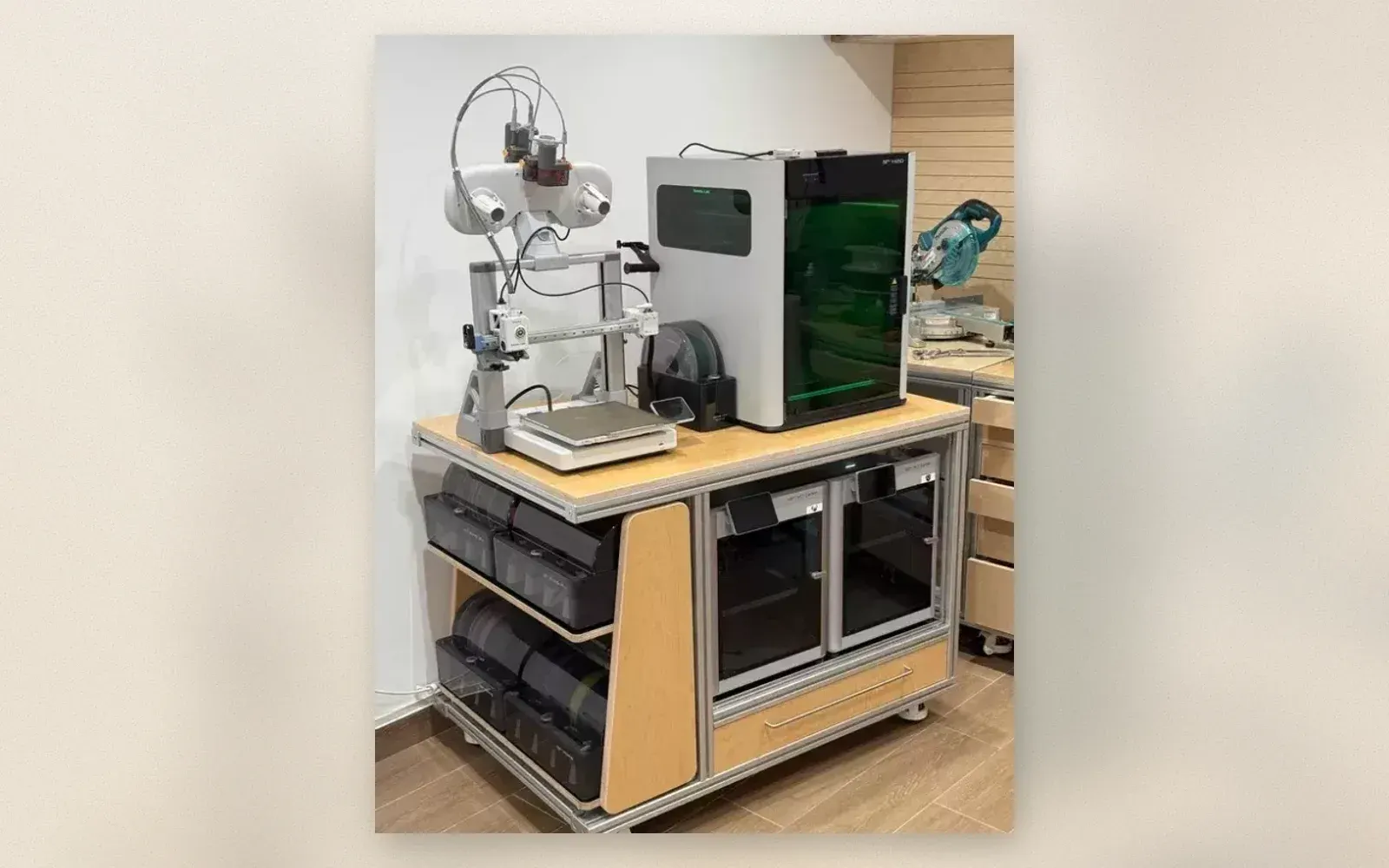
Bambu Lab workspace organization starts with a simple problem: once you own more than one printer, every flat surface in the room disappears under machines, spools and cables. The setup in these photos solves it with a single rolling station. An aluminum extrusion frame carries birch plywood panels and four locking casters. Two enclosed printers live in the lower shelf, two more machines sit on top, a drawer takes the tools, and a column of black dry boxes holds every spool the printers consume. The whole thing fits in roughly one square meter of floor and rolls out of the way when the workshop needs space for something else.
What does a working Bambu Lab workspace actually need?
Four zones, and the photo shows all of them. A printing surface tall enough that you can reach the build plates without bending, which the wooden top provides. A machine layer below for the printers that run long jobs unattended. A filament zone with sealed boxes so humidity never reaches the spools. And a power and cable path that keeps nothing draped across a walkway. When each zone exists before the next printer arrives, adding a machine means rearranging one shelf instead of rebuilding the room.
Why put 3D printers on a rolling workstation?
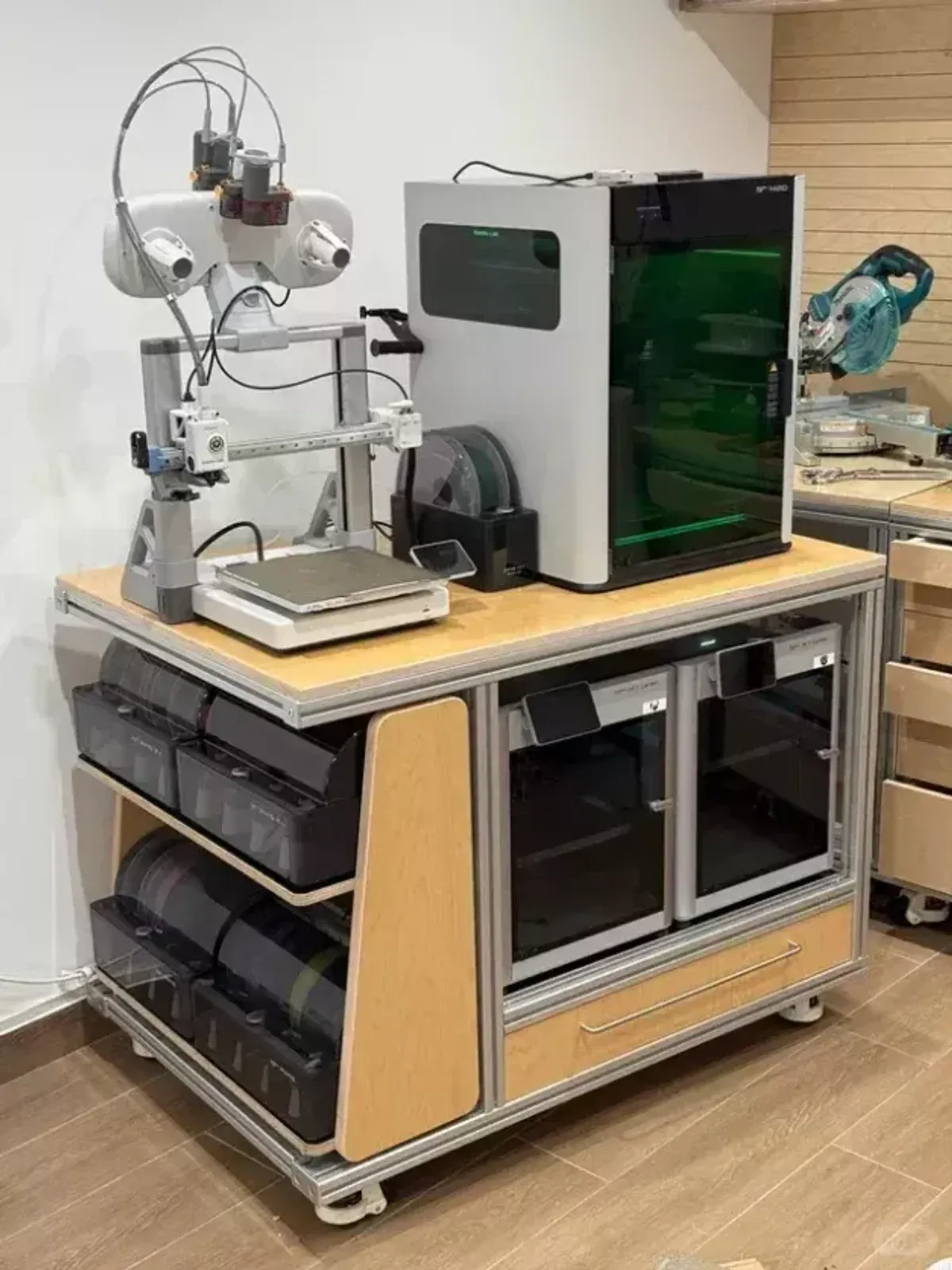
Because printers are serviced from the back, and the back is usually against a wall. The spool holder, the power switch and the PTFE inlet on a Bambu Lab printer all sit at the rear. On this station you unlock the casters, roll the whole assembly a meter forward, and every port is within reach for loading filament, cleaning the rods or blowing out dust. The casters lock again before a print starts, and the extrusion frame does not wobble at 500 mm/s speeds. The drawer underneath keeps scrapers, nozzles and hex keys one step from the machines that need them.
Where do the extra printers go when the top is full?
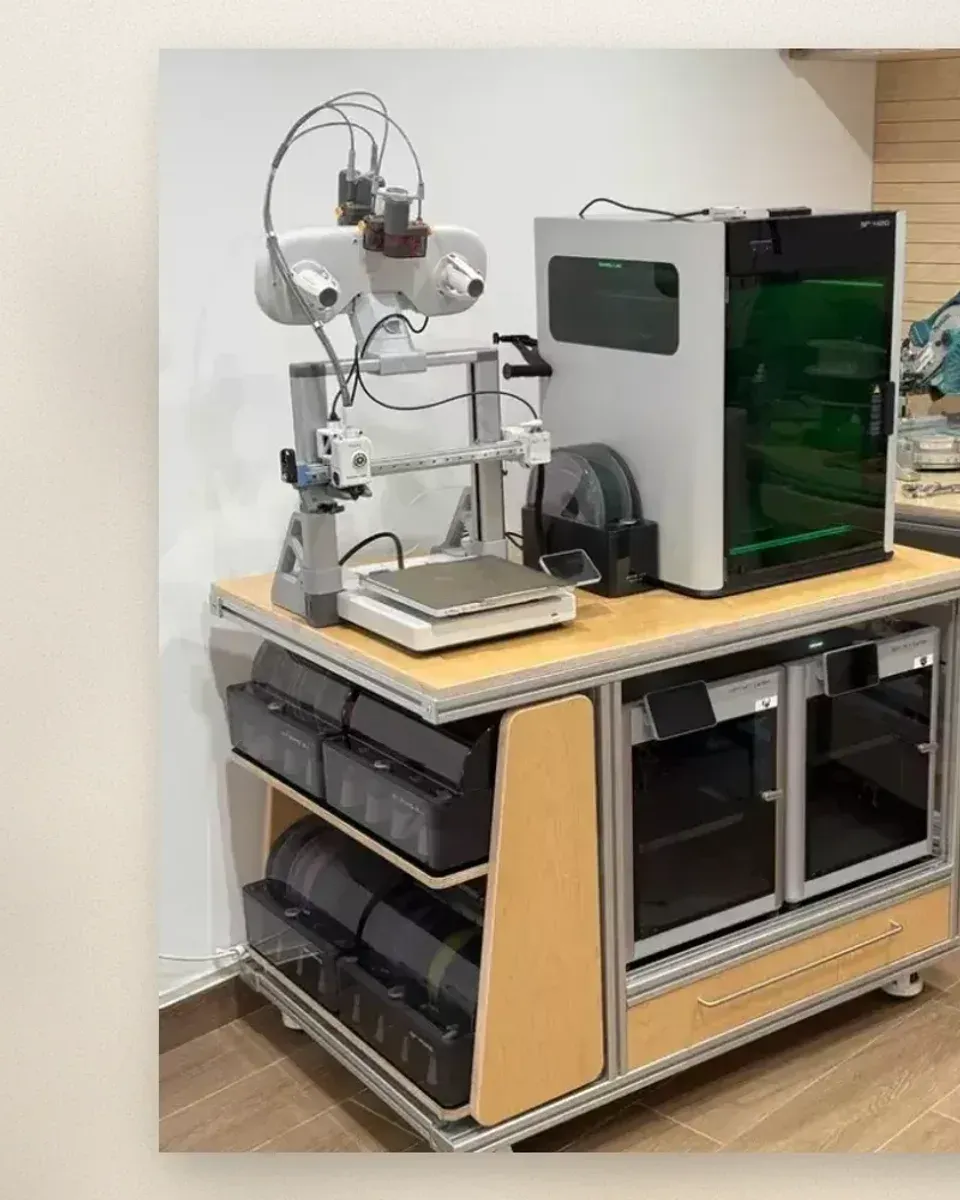
On the lower shelf, as the two enclosed machines in the photo demonstrate. The cubby height leaves room for the lid to open and for warm air to move around the case, and the floor of the cart carries their weight without the top surface turning into a tower. Printers that run overnight belong down here anyway: they stay out of the light, out of the way, and behind closed doors when the workshop doubles as a living space. Leave a hand’s width behind each machine so the power cables and the bowden tubes exit without a hard bend.
How do you keep filament dry and findable?
In stackable dry boxes with the spool standing where you can read its label. The shelves on the left of the station hold a row of them, each box sealed with a gasket around the lid. That matters more as a printer fleet grows, because a drawer of half-open spool bags turns into a drawer of snap-free PLA within a few humid weeks. For spools that are already questionable, an active dryer pulls the moisture back out.
The S4 takes four spools at once, monitors the humidity itself and feeds filament out through a port while the lid stays closed. Mounted on a shelf above the printer, as the white unit over the open-frame machine in the photo does, it doubles as the feed station: dry filament, straight into the toolhead, no intermediate spool holder collecting dust.
Verdict
One rolling station beats a wall of furniture for a growing printer fleet. Four machines, a drawer of tools and a shelf of dry boxes compress into a footprint you can still walk around, and the casters turn any maintenance job into a ten-second task instead of a wrestling match with a heavy cabinet.
✅ Pros
- Four printers in roughly one square meter of floor space
- Casters give access to the rear ports of every machine
- Sealed dry boxes keep every spool visible and dry
- Extrusion frame accepts new shelf positions as the fleet grows
❌ Cons
- Plywood and extrusion building takes an afternoon and some patience
- Two layers of printers means bending down for the lower jobs
- Filament dry boxes and the S4 add cost beyond the printers themselves
FAQ
How many 3D printers fit on one workstation?
In the setup shown here, four. Two enclosed machines share the lower shelf of the cart, and two more printers sit on the wooden top surface. The frame is aluminum extrusion with birch plywood panels, so the shelf spacing can be moved to fit the machines you own.
Do Bambu Lab printers need an enclosure?
The P1S ships as an enclosed printer with a 256 x 256 x 256 mm build volume and a top speed of 500 mm/s, so it brings its own chamber and prints ABS or ASA without a surrounding cabinet. Open-frame printers in the same workspace handle PLA and PETG, which are less sensitive to drafts.
What is the best way to store filament in a small workshop?
Sealed dry boxes that each hold one spool, stacked so the labels face out. A four-spool station such as the SUNLU S4 adds active drying with automatic humidity control, and it can feed the printer directly through a PTFE tube while the spool stays sealed inside.

Continue reading

HiMirror Slide Review: The Smart Beauty Mirror That Grades Your Skin
A vanity mirror with a sliding tablet that photographs your face and counts wrinkles, pores and dark circles. What the HiMirror Slide gets right after weeks of use.
Pink Desk Setup: The Gear Behind a Pink Microphone, MIDI Keyboard and a Calm Streaming Corner
A pink condenser mic with a boom arm, a 25 key MIDI keyboard and a few cheap extras make a streaming desk that looks styled and still records clean audio.

10 Camera and Drone View Commands That Change How Your Photos Look
Droneview, topdown, birdseye, lowangle: what the ten view commands from the viral cheat sheet mean, and how to shoot them with AI prompts or a real drone.