Portrait Photography Angles: 16 Camera Positions Worth Working Through
Front, quarter, profile, back, each again from low and high: what the 16-angle portrait reference sheet teaches, and the 50mm lens that suits the job.
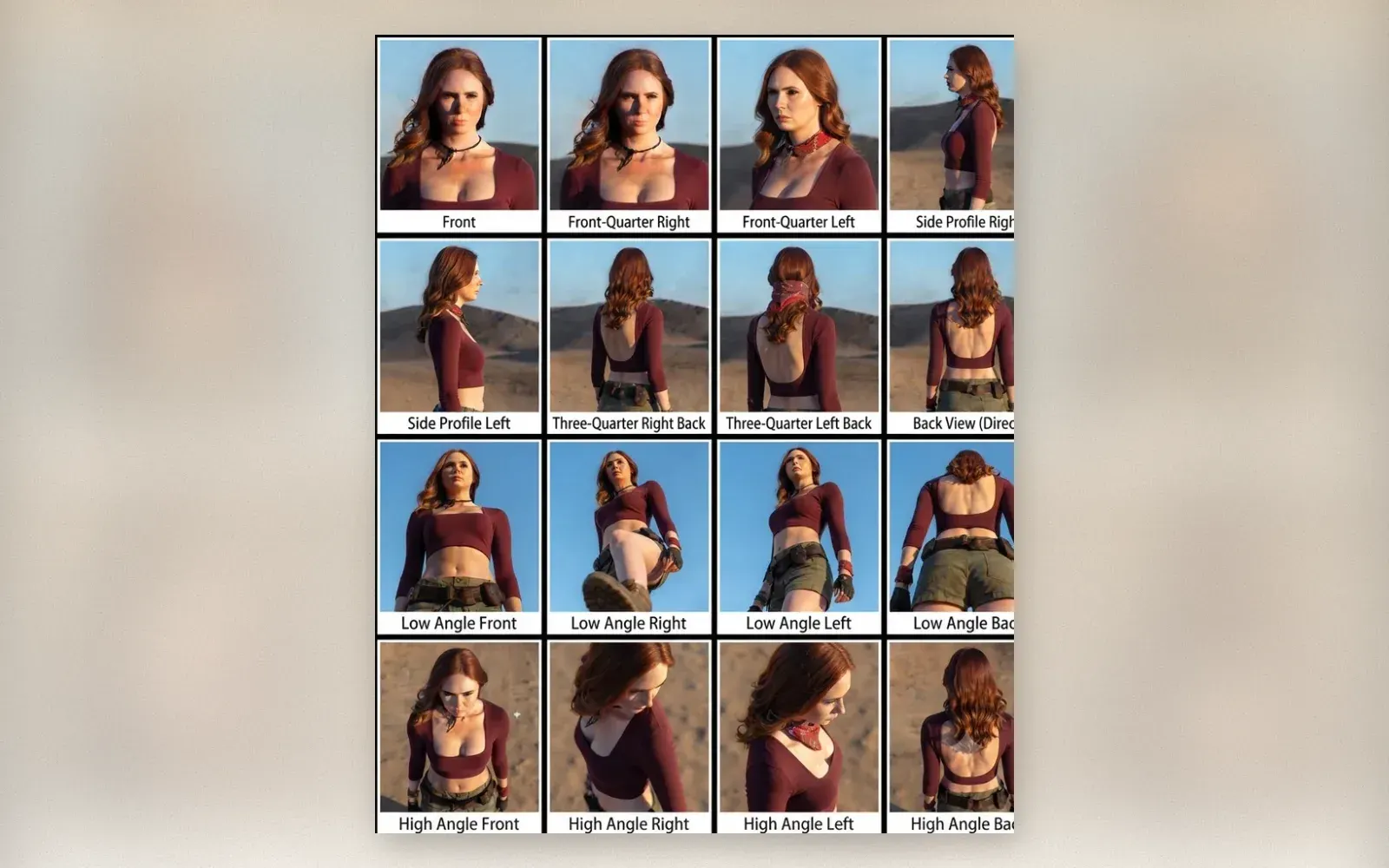
The portrait photography angles reference sheet making the rounds photographs one model in a desert setting from sixteen labeled positions arranged in four rows: front and its quarter variants, the profile and back views, then the whole circle again from a low camera and from a high one. The grid has the smooth look of an AI render, which is exactly why the same face holds every panel, and that consistency is what makes it useful as a reference. Photographers can treat it as a shot list for a real session, and anyone generating portraits can lift the labels straight into prompts. Working the full circle once teaches which angle carries which feeling, and a 50 mm f/1.8 like the Canon RF 50mm F1.8 STM is the natural glass for the job.
What are the 16 portrait angles on the reference sheet?
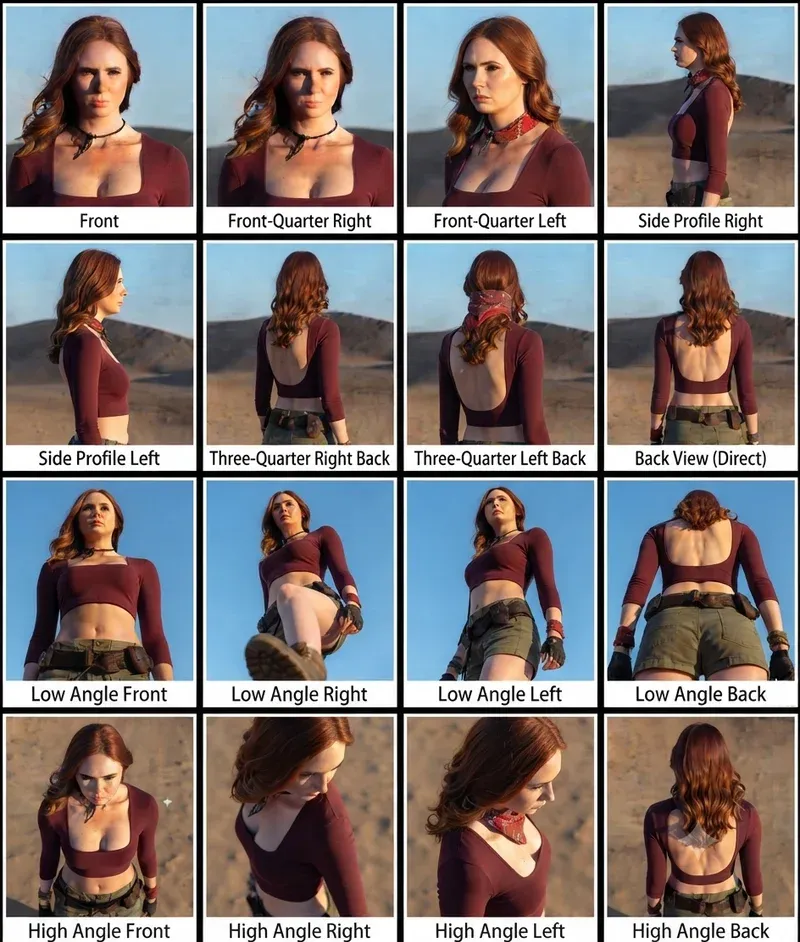
The sheet organizes sixteen panels into three groups: a full circle around the subject at neutral height, then that circle compressed into four low-angle views, then four high-angle ones. Read row by row, it doubles as a shooting order.
Row one and two, the neutral circle:
- Front: camera dead ahead, both eyes level, the honest record
- Front-Quarter Right and Left: face turned about 45 degrees, the professional default
- Side Profile Right and Left: full 90 degrees, silhouette and jawline do the talking
- Three-Quarter Right Back and Left Back: subject turned away past profile, hair and back of the outfit lead
- Back View (Direct): straight from behind, all mystery, subject looks into the scene
Row three, low angle versions: Low Angle Front, Low Angle Right, Low Angle Left, and Low Angle Back, each shot from below the subject’s chest.
Row four mirrors it from above: High Angle Front, High Angle Right, High Angle Left, and High Angle Back.
The 45-degree steps matter more than they look. Quarter turns keep both eyes visible while removing the passport-photo flatness, and the back-half of the circle is where candid energy lives.
How do you work through all 16 angles in a real shoot?
Keep the subject planted and move the camera instead. Repositioning a person costs time and breaks their expression, while the photographer walking a slow circle costs nothing. Start at neutral height for the eight front-to-back positions, stepping 45 degrees at a time, then crouch below chest height for the low row, and finish on a step or stool for the high row.
Two practical notes. Talk through the circle as you go, because a subject who knows the order relaxes into it, and count your panels: sixteen frames of one setup sounds like a lot until you check a contact sheet and find half of them done. A full pass takes 20 to 30 minutes at a relaxed pace.
Which angle should you choose for which look?
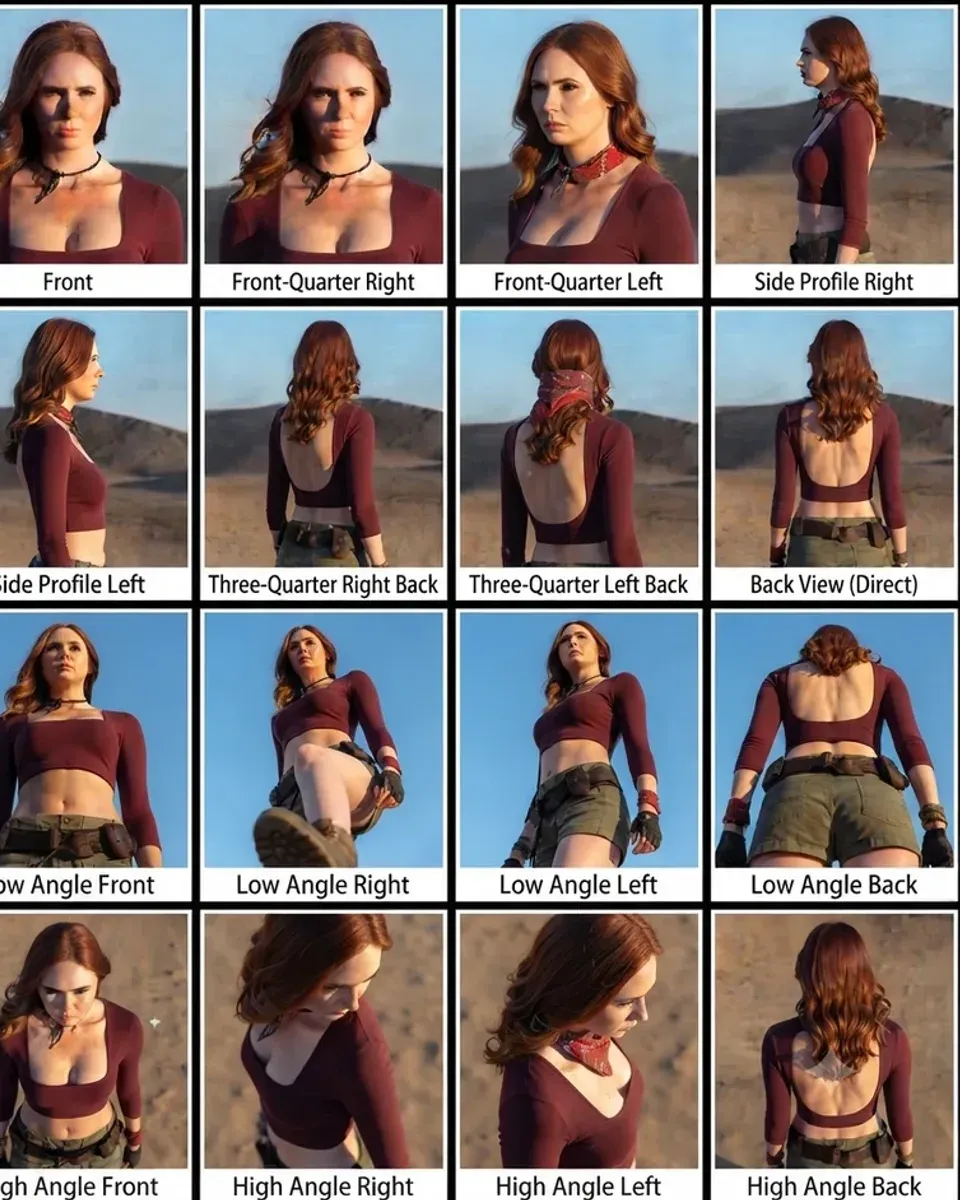
Front-quarter is the safe answer when in doubt, profile when you want graphic, back when you want mystery. The low row adds status: subjects shot from below gain height and authority, the background simplifies into sky, and Low Angle Front reads heroic even in an ordinary field. The high row does the opposite, shrinking the subject and pulling the viewer into a protective position, which suits quiet, intimate frames.
The back-half panels earn their slot more than beginners expect. Three-Quarter Back and Back View show hair, outfit, and setting while hiding the face, and they routinely become the favorite frame of a set because they feel like a moment overheard rather than a portrait posed. If you only have time for six frames, take Front-Quarter, Profile, Three-Quarter Back, Low Angle Front, High Angle Front, and Back View.
Why shoot the sheet with a 50mm f/1.8?
Fifty millimeters sits close to the perspective of natural viewing at portrait distance, so faces render the way you would see them standing there, without lens compression arguments or nose-widening. At f/1.8 the background falls away behind the subject, which gives every one of the sixteen positions the separation that makes the angle choice visible.
The Canon RF 50mm F1.8 STM is the current budget way into that look on EOS R bodies. It is small enough to swing around a subject twenty times, focuses fast and quietly thanks to the STM motor, and takes 43 mm filters. At around 189 euros it costs less than the outfit the subject wears, and it turns any R-series body into a competent portrait kit.
Verdict
The 16-angle sheet works because it converts a vague brief like “give me some variety” into sixteen named positions with a natural shooting order, and one pass through them teaches angle language faster than years of improvising. Shoot the circle neutrally, repeat it low, repeat it high, keep a 50 mm prime on the body, and cull later.
✅ Pros
- Sixteen labeled positions remove the where-do-I-stand freeze from sessions
- The sheet doubles as a prompt vocabulary for consistent AI portrait sets
- An RF 50mm f/1.8 covers every panel for around 189 euros
❌ Cons
- Sixteen frames per setup produces heavy culling and many near-duplicates
- The reference render flatters with a face no real session can hold constant
- Wide open at close range, f/1.8 gives you a thin margin for focus misses
FAQ
What are the 16 portrait photography angles?
They are eight camera positions around a standing subject, front through quarter and profile to back, each repeated from below and from above. That gives front, front-quarter, side profile, three-quarter back, and direct back view in low angle, high angle, and neutral height versions.
Which portrait angle is most flattering?
The front-quarter view is the reliable default. It shows both eyes, adds depth by turning the face slightly away from the camera, and sharpens the jawline, which is why it dominates professional headshots. Full front reads more confrontational, profile more graphic.
What lens suits shooting a full angle set?
A 50 mm f/1.8 prime is the classic pick. Its perspective matches natural viewing distance at portrait range, f/1.8 separates the subject from the background, and the small size matters when you are circling a subject twenty times in one session.

Continue reading
10 Camera and Drone View Commands That Change How Your Photos Look
Droneview, topdown, birdseye, lowangle: what the ten view commands from the viral cheat sheet mean, and how to shoot them with AI prompts or a real drone.
Camera Settings Cheat Sheet: 10 Scenes With Aperture, Shutter Speed, and ISO
Portrait, landscape, action, night: the ten setting combos from the widely shared camera cheat sheet, why each one works, and the camera to practice them on.
Canon 5D Mark III Video Rig: Every Piece in This Flat Lay Explained
A working Canon 5D Mark III video rig in one flat lay: Rode shotgun mic, battery grip, telephoto glass, speedlite, and the small parts that keep a shoot alive.